


Picture someone who makes leather bags and sells them on Instagram. A new follower likes a photo and comments with one word: “Price?” By evening the same question has arrived five times in the comments and twice in direct messages, and someone else wants to know where the workshop is. Nothing is wrong with the business. The answers have simply ended up in too many places.
Is Instagram enough for your business, or is this the point where a website would help? The honest answer depends on what is actually getting in your way, and this article is meant to help you work that out. The short version: Instagram is enough for more businesses than people who build websites tend to admit, and when it stops being enough, the signs are usually easy to recognise.
What Instagram does well
It is where your customers already are. Nobody has to be persuaded to visit a new address; you post a photo and it appears next to the things they opened the app to see. For a business that sells something visual, such as food, clothing, ceramics, interiors or a haircut, a feed works as a surprisingly effective catalogue, and stories and reels give people a sense of who is behind it.
It is also a conversation. A customer can ask a question under a photo, haggle a little, send a picture of the room the sofa is meant for, and hear back from a real person within the hour. That closeness is hard to reproduce on a website, and it is a large part of why people choose small businesses in the first place.
And it costs almost nothing to start. If you are still finding out whether anyone wants what you make, a profile lets you test the idea over a weekend, change the offer on Tuesday and learn from the reactions. Spending months on a website before you know what you are selling is, for most people, the wrong order of things.
When the details start to scatter
Trouble rarely arrives as a dramatic failure. It arrives as small, repeated friction.
Information gets spread out. The price is in a caption, delivery terms in a highlight, opening hours in a story that expired yesterday, and the one detail a customer needs is in a post from 8 months ago. A profile is arranged by date, not by what a visitor is trying to find, and there is no good way to offer “browse by size” or “everything under a certain price”.
Answering becomes a daily job. Each question is easy on its own, but 50 of them a week amounts to a part-time position nobody hired for. Because the answers live in private messages, they are never written down anywhere a new customer could find them.
Orders pile up in chat. A request comes in on Instagram, a payment confirmation on WhatsApp, an address by email, sometimes spelled two different ways. With a few orders a week that is manageable. With a few dozen, mistakes start to cost money and goodwill, and nobody can say quickly what is in stock.
Whose space it is
Instagram lets you add a few links to your profile, up to 5 according to its own help pages, but a post is still mostly a picture and a caption, and your page looks the way Instagram decides it looks. Reach shifts with the platform’s priorities, features come and go, and accounts can run into restrictions that have nothing to do with the quality of the work. None of this makes Instagram unreliable. It means you are a tenant, and the terms of the lease are not yours to write.
There is also the question of who finds you. Instagram’s help pages note that search engines may index some public photos and videos, but you do not decide how, or whether, your business shows up there, and someone searching for a service by name and city may never think to look inside the app.
What a website adds, and what it does not
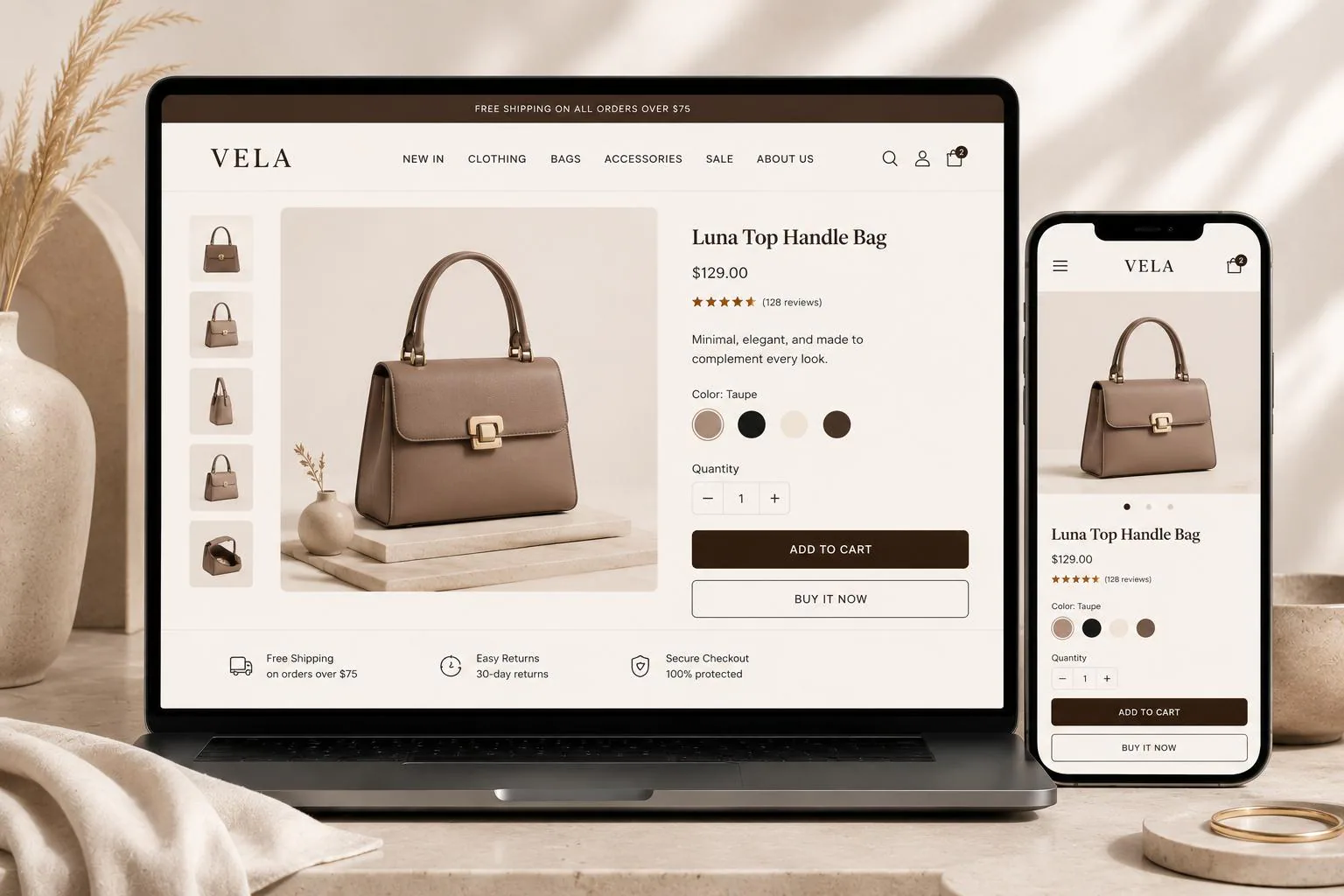
A website is, first of all, a place where information is arranged the way a visitor looks for it. Each product or service gets its own page, with price, sizes, photos and conditions in the same spot every time. Hours, address and contact details have one home. The questions you answer every day get answered once, in writing, where the next person will find them.
If the site is built to take orders, requests arrive in a structured form instead of as scattered messages. What a site can actually handle, such as payments and delivery options, depends on where you sell, so ask before you assume. The address is yours as well: it does not change with the platform’s moods, it can go on a box or a business card, and it can be found by people who search rather than scroll.
What it does not do is bring customers on its own. A new website is a shop on a street nobody walks down until something sends them there: Instagram, word of mouth, advertising or, eventually, search. Google is explicit that it does not guarantee that any page will be crawled, indexed or shown, and its beginner’s guide says changes can take anywhere from a few hours to several months to have an effect. Showing up in search comes from useful pages, clear information and steady work, not from launching.
A site also needs looking after. Opening hours that are wrong on a website are worse than none, and a product that sold out in March but is still listed in June costs a customer’s trust. A website only helps if someone keeps it true, and a clear, current Instagram profile beats a neglected website every time.
That is why the useful question is rarely Instagram or a website. They do different jobs. Instagram earns attention, a website holds answers, and a common arrangement is to use the first to send people to the second.
Is Instagram enough for your business right now?
If you are still working out what you sell, who buys it and at what price, then probably yes, and it may be the best choice you have. Your offer is changing every few weeks, and a website would be out of date almost as soon as it was written. Put the effort into the profile: a clear bio, a way to get in touch, prices or a note on how you quote, and the answers to the 3 questions people ask most, in a highlight or a pinned post.
The same goes for plenty of established small businesses that run well on word of mouth and a core of regulars. A hairdresser with a full diary, a baker who sells out by noon, a tutor with a waiting list: if people can find you, can reach you and nothing is slipping through, a website would mostly be a second place to keep tidy. It can wait until it solves a problem you actually have.
The picture changes when demand is steady and the same details are repeated all day, and again when the operation itself grows more complicated: dozens of products in different sizes and colours, bookings and deliveries to coordinate, several people sharing one inbox. At that point the cost of mistakes and wasted hours can overtake the cost of building something properly, and a website, or occasionally a small piece of custom software behind it, repays itself in time and clarity rather than in anything dramatic.
Signs it may be time to build one
None of these is a rule on its own. Two or three at once is a signal worth taking seriously.
You answer the same handful of questions every day (price, delivery, address, availability) and typing them again has started to wear you down.
Customers ask for something they can send to a partner, a colleague or an accountant: a page with the details, not a screenshot of a story.
Orders or bookings get mixed up, doubled or lost between messages, and you cannot tell at a glance what is in stock.
Customers from other cities or countries ask how to order, pay and receive, and you walk each of them through the same steps.
Companies, institutions or larger clients ask whether you have a website before they will work with you.
You are paying for ads, or relying on the link in your bio, and the place people land is a scrolling grid of photos.
You have thought about what would happen if your account were out of reach for a week, and the honest answer is that customers would not know how to find you.
A quick test: write down the 5 questions customers ask you most. If one clear page could answer all 5, and they will still be the same questions next month, a website would probably help. If the answers keep changing, you are still shaping the business, and it is fine to wait.
A way to decide
Before spending anything, work out which problem you actually have. If the trouble is attention, too few people seeing your work, a website will not fix it first; better photos, steadier posting, partnerships and customers who recommend you will. If the trouble is answers, people who want to buy and then stall over price, stock, delivery, trust or paperwork, a website treats the part that hurts.
We build websites for a living, so it is fair to discount our opinion a little. The advice we would give a friend is the same either way: start where your customers already are, notice what keeps slowing you down, and build for that, at the size your business is now rather than the size you hope it will reach. A first website can be small. It only has to be clear and kept up to date.
If you are weighing a first website and want to see what it involves, our pricing page lays out the plans, what each one includes and how projects are paid for, and you are welcome to write to us with questions at any point.
Comments
0No comments yet